Read this before submitting a DTF order. By placing an order with Blank Garment you accept the terms below.
You are fully responsible for ensuring you have the legal rights, licences, or permissions to use any artwork, logos, characters, or trademarks you submit to us for printing. By uploading a file you affirm ownership of the design or that you have obtained the proper permissions.
We will refuse to print any design containing copyrighted or trademarked material (TV/movie characters, sports logos, brand marks, music artists, etc.) unless you provide written proof of authorisation from the rights holder.
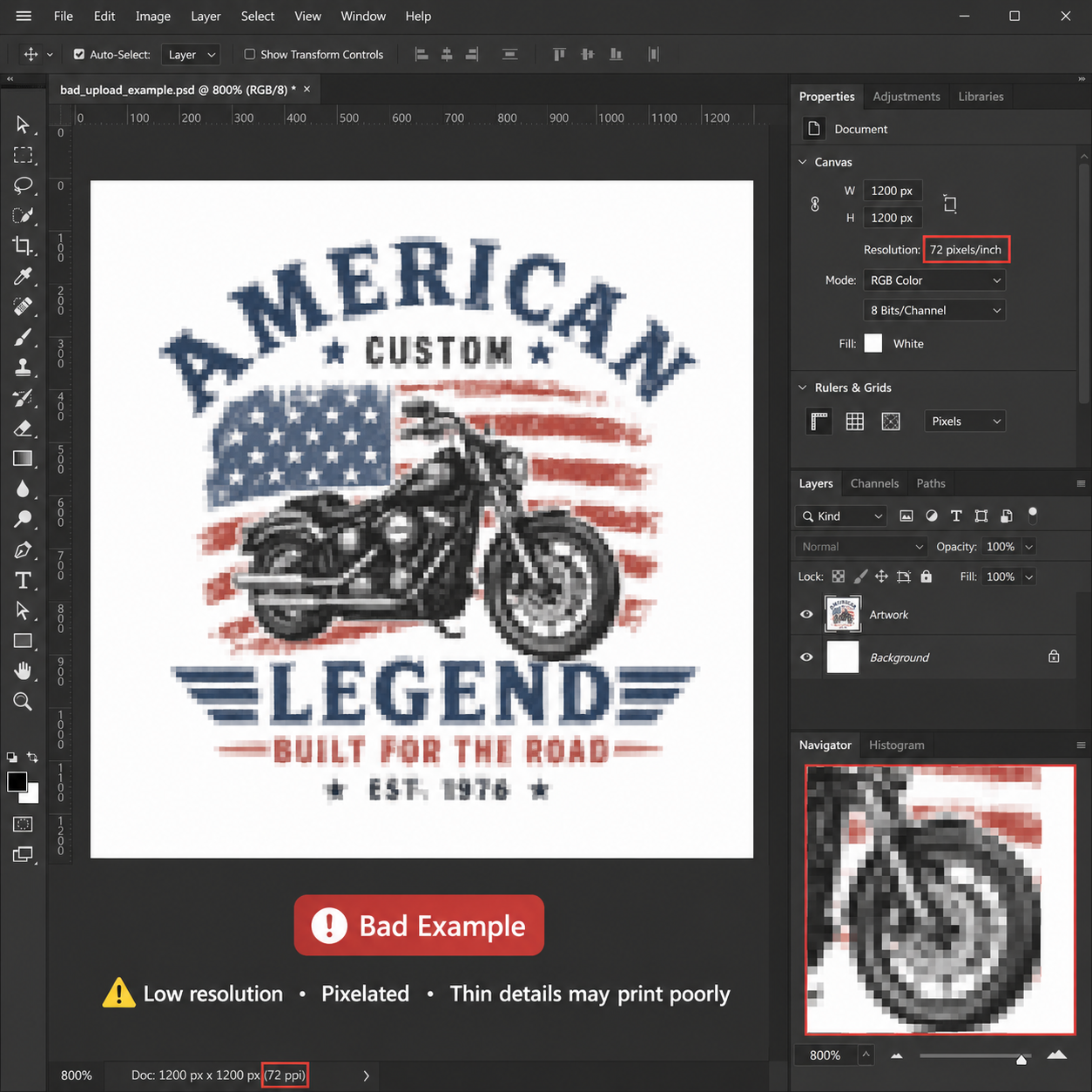
Screens display images at 72–110 PPI. A printer lays down dots at 300 DPI. The image you see on screen can look sharp at 5"×5" but print blurry at the same size — a screen-ready image is roughly 4× too small for print at the same dimensions.
Use this table to check whether your file is large enough for the print size you want:
| Pixel dimensions | Max print at 300 DPI | Use case |
|---|---|---|
| 600 × 600 px | 2" × 2" | Sleeve hit, small accent |
| 1 200 × 1 200 px | 4" × 4" | Pocket / left-chest |
| 2 400 × 2 400 px | 8" × 8" | Youth full-front |
| 3 000 × 3 000 px | 10" × 10" | Standard adult chest print |
| 4 500 × 4 500 px | 15" × 15" | Adult full-front (max for most tees) |
| 6 600 × 6 600 px | 22" × 22" | Edge-to-edge of our film |
Formula: max print width (in) = pixel width ÷ 300.
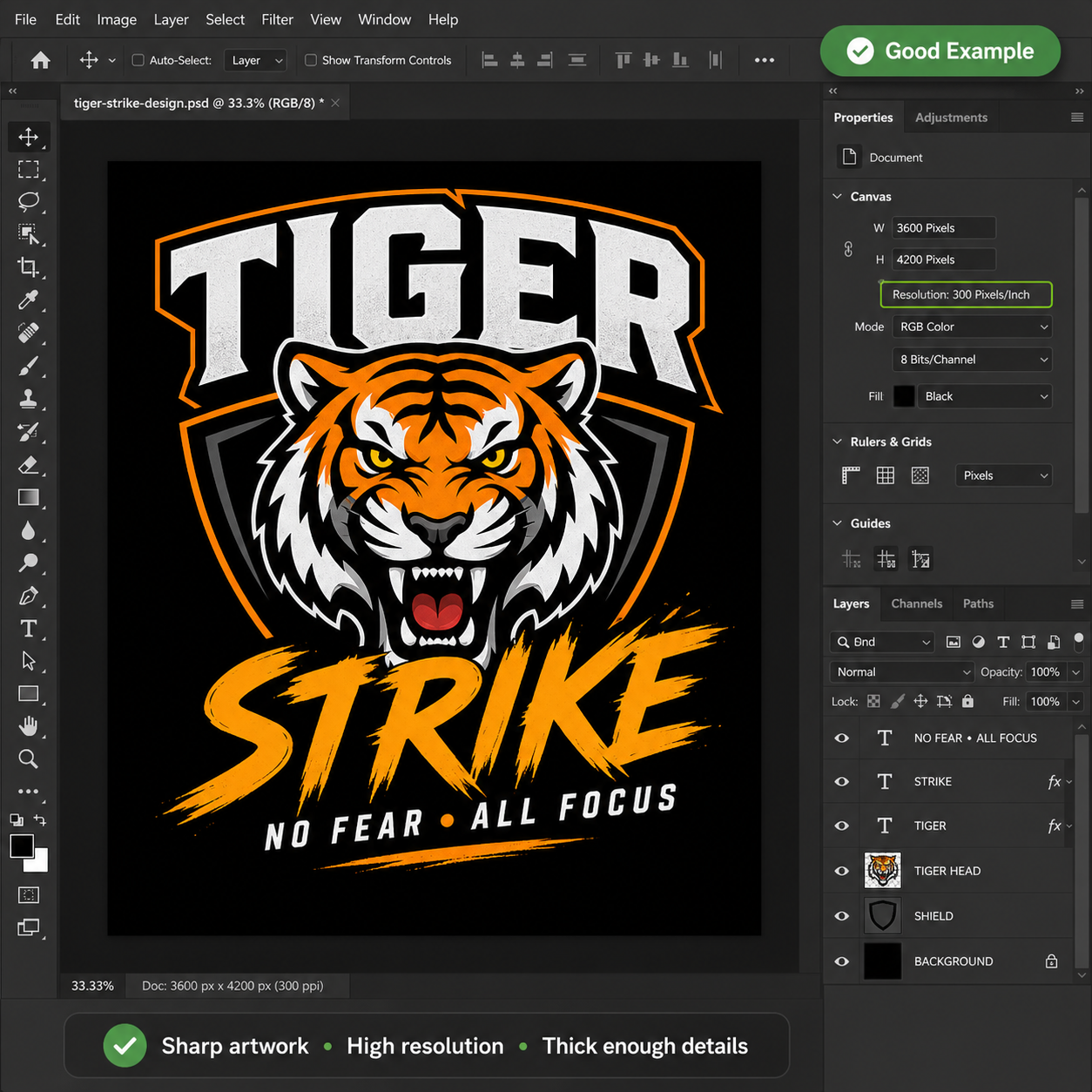
Every DTF print on a dark garment is built in two passes: a colour layer plus a white underbase ink layer that the RIP auto-generates beneath every non-transparent pixel. The underbase is what makes colours opaque on dark fabric.
The RIP applies a small "choke" (typically 2–5 px) that pulls the white inwards so it doesn't peek out behind the colour edges. The side effect: any stroke thinner than the choke disappears. Plan a safe floor of 1.5 pt strokes / 6 pt minimum text size. Features below that may print on a flat swatch but break on textured fabric or near seams.
Blank Garment prints your file exactly as uploaded. We do not modify customer files — no resizing, no color correction, no spelling fixes, no layout changes. By submitting your file you confirm it is final and ready for print.
Blank Garment is not responsible or liable for errors in spelling, color, or design in any artwork submitted by the client. We are not responsible for any errors or omissions after you have approved your order.
If your design needs adjustment before printing, email info@blankgarment.ca before placing the order. We're happy to discuss what's possible — but once your order is placed it goes straight to the printer as-uploaded.
All custom DTF prints are final sale. We do not offer refunds, exchanges, or reprints for orders printed from low-resolution, low-contrast, or otherwise non-print-ready files supplied by the customer.
We will reprint or refund only when the production defect is on our side — misregistration, ink failure, mis-cut, or a miscount on our end.
By placing a DTF order with Blank Garment, you accept the terms above.
 Buying Bulk?